What is Polycarbonate? The Ultimate Guide to PC Plastic Properties & Fabrication
Engineered for performance, Polycarbonate (PC) is a transparent powerhouse, delivering up to 250 times the impact strength of glass while remaining lightweight and highly workable.
But beyond strength, understanding what polycarbonate actually is, and how it behaves in real-world conditions, is what determines whether it’s the right material for your job.
This guide breaks down what polycarbonate is, its key properties, limitations, and fabrication considerations, giving you a practical, engineering-focused view of how PC plastic performs.
What Material is Polycarbonate? (Chemical & Structual Makeup)
Polycarbonate is a thermoplastic polymer composed of carbonate groups, giving it a unique balance of rigidity and toughness. Unlike other plastic materials, it behaves in a ductile manner, absorbing force rather than cracking under stress.
Table 1. Material Comparison between Polycarbonate, Acrylic and Glass.
| Ploycarbonate | Acrylic | Glass |
|---|---|---|---|
| Impact Resistance | Extremely High | Moderate | Low |
| Weight | ~50% of glass | ~50% of glass | Heavy |
| Light Transmission | 88–90% | ~92% | ~90% |
| Refractive Index | 1.584–1.586 | ~1.49 | ~1.52 |
So why is the index of polycarbonate important? The refractive index is critical in optical design, allowing polycarbonate to efficiently bend light while maintaining clarity.
And what about BPA?
Polycarbonate is traditionally manufactured using BPA-based processes. However, BPA-free variants are available for applications requiring strict compliance, including food-grade and medical environments.
Key Advantages of Polycarbonate
Virtually unbreakable: Polycarbonate doesn’t shatter; it bends before it breaks. This ductile behaviour makes it ideal for high-impact and safety-critical applications.
Natural UV shield: Polycarbonate with UV protection blocks over 99% of UV radiation. It works by absorbing UV rays and preventing them from passing through.
Thermal efficiency: It provides up to 60% better heat retention than glass, making it highly effective in greenhouse and building applications.
Lightweight strength: At half the weight of glass, polycarbonate reduces structural load and simplifies installation without compromising performance.
Disadvanatges & Limitations
Scratch Resistance: Does polycarbonate scratch easily? Yes. Its surface is softer than glass, making it prone to scratching. Hard-coated grades are recommended for high-wear environments.
Chemical sensitivity: Polycarbonate resists oils and diluted acids but degrades when exposed to acetone, ammonia, and high-alkaline cleaners.
Heat and flammability: While many grades are self-extinguishing, polycarbonate has a heat deflection temperature of around 135–140°C, limiting its use in continuous high-temperature environments.
Applications and Uses: Where is Polycarbonate Used?
Polycarbonate is best understood by matching its properties to performance requirements.
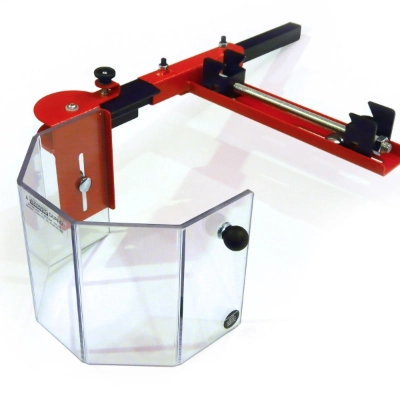
Safety & security (impact strength): Used in bullet-resistant glazing, riot shields, and bank security screens. In industrial settings, 10mm polycarbonate is widely considered the benchmark for high-velocity machine guarding.
Optical & eyewear (refractive index): Its refractive index (1.584 - 1.586) supports high-performance lenses, safety eyewear, and optical components.
Medical devices (sterilisation capability): Polycarbonate is used in blood oxygenators and surgical tools, and can be autoclaved at 121°C, although repeated cycles may cause hydrolytic degradation and micro-cracking (crazing).
Construction (UV resistance and weight): Common in skylights, roofing systems, and greenhouse panels, where durability and light transmission are critical.
Electronics (insulation): Used in laptop housings, connectors, and protective phone covers due to its electrical insulating properties.
Fabrication Guide: Can You Work With Polycarbonate
Polycarbonate is highly workable.
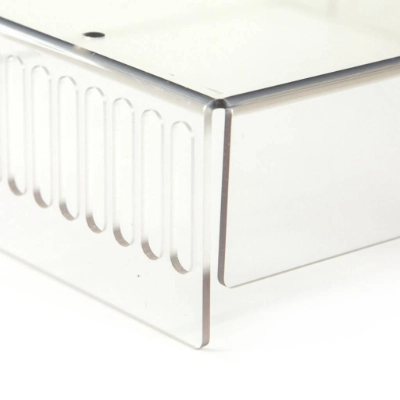
Cutting: Polycarbonate can be cut using circular saws or jigsaws. CNC routing is preferred for precision work.
Drilling: You can drill into polycarbonate using HSS bits, but plastic-specific drill bits are recommended to prevent grabbing and internal stress.
Shaping & bending: Polycarbonate can be subjected to cold bending/curving using the 150× rule: Minimum bend radius = 150 × sheet thickness.
Heat-bending is used for tighter radii and controlled forming.
Laser cutting vs CNC routing: Polycarbonate can be laser cut, but it often results in edge charring or yellowing rather than clean cuts. CNC routing provides cleaner edges and better dimensional accuracy, especially for thicker sheets.
Joining methods: There are a few safe methods for joining polycarbonate materials:
- Solvent bonding (chemical fusion using agents like methylene chloride)
- Ultrasonic welding for precision components
- Hot gas welding for structural joins (but not common)
Finishing: Polycarbonate can be painted using water-based or acrylic paints. Solvent-based coatings should be avoided to prevent stress cracking.
Durability & Safety Standards
Does polycarbonate shatter? No. It resists shattering or splintering and instead dents or deforms under extreme force.
How strong is 10mm polycarbonate? At 10mm thickness, polycarbonate reaches an industrial “sweet spot,” suitable for high-impact machine guarding and certain ballistic-rated glazing applications.
Can polycarbonate be autoclaved? Yes, typically at 121°C. However, repeated sterilisation cycles can lead to long-term material degradation.
Sustainability & Recycling
Can polycarbonate be recycled? Polycarbonate is classified as Resin Code #7 (“Other”), which makes conventional recycling streams limited.
However, it remains valuable in industrial recycling through mechanical regrinding and reuse. Advanced chemical recycling methods can also recover base monomers, supporting circular material use in engineered applications.
Expert Polycarbonate Fabrication & Supply
Selecting polycarbonate is only part of the equation; how it’s cut, formed, and finished determines real-world performance.
For engineered applications requiring precision machining, UV-stabilised grades, or abrasion-resistant coatings, working with a specialist supplier ensures consistency, compliance, and reliability.
Explore Dotmar’s polycarbonate sheet options and fabrication support here:
PALSUN AR (Abrasion Resistant)
And if you need extra support or custom-cut PC or industrial fabrication, contact our Dotmar team.
Frequently Asked Questions
What is the refractive index of polycarbonate? Between 1.584 and 1.586, making it ideal for optical clarity and lens applications.
Is polycarbonate better than acrylic for outdoor use? Polycarbonate offers superior impact resistance ideal for outdoors, while acrylic provides better scratch resistance and slightly higher clarity.
How do you clean polycarbonate without scratching it? Use mild soap, water, and a microfiber cloth. Avoid abrasive or ammonia-based cleaners.
What is the lifespan nof a 10mm PC sheet Outdoors? Typically 10–15 years.