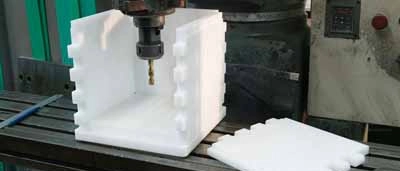
Dotmar provides plastic milling services for industrial applications where dimensional accuracy, material performance, and reliable repeatability matter.
Working across a broad range of engineering plastics, our Dotmar technicians machine-milled plastic components to suit specific operating requirements, whether for prototypes, replacement parts, or repeat production runs.
With both machining expertise and a strong understanding of plastic behaviour under load, heat, and cutting conditions, our focus is on providing precise, reliable, and high-quality plastic milling solutions
What is Plastic Milling?
Plastic milling is a machining process that uses rotary cutters to remove material from a plastic workpiece, creating finished components with precise dimensions and complex features.
Plastic milling allows for detailed machining of shapes, contours, and intricate geometries. Because the process is highly controlled, it can achieve tight tolerances, smooth finishes and consistent results across multiple parts.
For engineering plastics, expert plastic milling helps preserve material integrity by controlling heat generation, cutting speed, and chip removal during machining.
Advantages of Milling for Plastic Components
Plastic milling offers several practical manufacturing advantages, making milling well-suited to both custom one-off work and repeat manufacturing where consistency matters.
- High precision and dimensional accuracy for close-tolerance components
- Capability to produce complex shapes and detailed features
- Smooth surfaces and clean edge finishes with minimal secondary finishing
- Versatility across many plastic materials, thicknesses, and part sizes
- Cost-effective machining for prototypes and low-volume production
- Reliable repeatability and consistency for larger production runs
Plastic Materials Suitable for Milling
Many engineering plastics machine well when plastic milling parameters are matched to material properties.
- Acrylic offers excellent clarity and finish quality, commonly used for visual components, guards, and fabricated parts.
- Polycarbonate provides strong impact resistance and toughness for demanding structural applications.
- PEEK is suited to high-performance technical environments requiring heat resistance, strength, and chemical stability.
- Nylon delivers excellent wear resistance, toughness, and mechanical strength.
- UHMWPE is valued for its low friction, abrasion resistance, and durability in high-wear applications.
Each material behaves differently during plastic milling. Dotmar’s experienced technicians ensure tooling, cutting speeds, and machining strategies are selected appropriately for the best performance and operational result.
Industries and Applications
Dotmar’s plastic milling services and milled plastic are ideal for applications where precision is essential.
- Automotive: Milled plastic parts are used for housings, wear components, brackets, and technical assemblies.
- Aerospace: Lightweight, high-performance milled plastic components are used where the strength-to-weight ratio matters.
- Medical manufacturing: Plastic milling supports precision devices, fixtures, and technical components requiring tight dimensional control.
- Electronics and industrial equipment: Milled plastics are commonly used for insulating parts, guides, machine elements, gears, and custom-fabricated assemblies.
Dotmar's Milling Capabilities
Dotmar combines advanced CNC plastic milling equipment, modern CAD/CAM programming, and material-specific machining knowledge to deliver accurate, repeatable results.
Machining conditions, tool selection, spindle speed, feed rate, and cutting path are all considered by Dotmar’s expert plastic milling technicians to achieve clean machining without distortion or unnecessary stress in the finished part.
Quality Control and Assurance
Quality is at every stage of the plastic milling process. Dotmar technicians carry out material inspection, machine calibration, in-process monitoring, and final dimensional and visual checks to ensure every milled component meets specification.
Our expert team at Dotmar is committed to delivering milled plastic components that are consistent, high-quality and meet or exceed your specifications.
Plastic Milling FAQs
1. What are the advantages of milling compared to other machining processes for plastics?
Plastic milling allows greater flexibility for complex shapes, close tolerances, and detailed machining features.
2. Which plastic materials are best suited for milling?
Acrylic, polycarbonate, PEEK, nylon, and UHMWPE are commonly milled with excellent results.
3. How precise and detailed can milled plastic components be?
Plastic milling can produce highly detailed parts with tight tolerances and consistent finish quality.
4. What industries commonly require plastic milling services?
Automotive, aerospace, medical, electronics, and industrial manufacturing regularly use milled plastic components.
5. How does Dotmar ensure the quality and accuracy of milled parts?
Through material selection, controlled machining parameters, calibration, and detailed inspection processes.
6. What are the three types of milling?
The main types are face milling, end milling, and profile milling.
7. What are the disadvantages of milling?
Milling can involve longer machining times and higher setup costs compared with simpler fabrication methods for basic parts.
Talk to the plastic milling experts at Dotmar
If your application requires precision-machined plastic components, speak with us at Dotmar about plastic milling solutions built around practical engineering, reliable machining, and consistent production quality.